
Santos Bravos and the global reinvention of Latin music

Originally posted on The Georgetonian on October 31, 2025
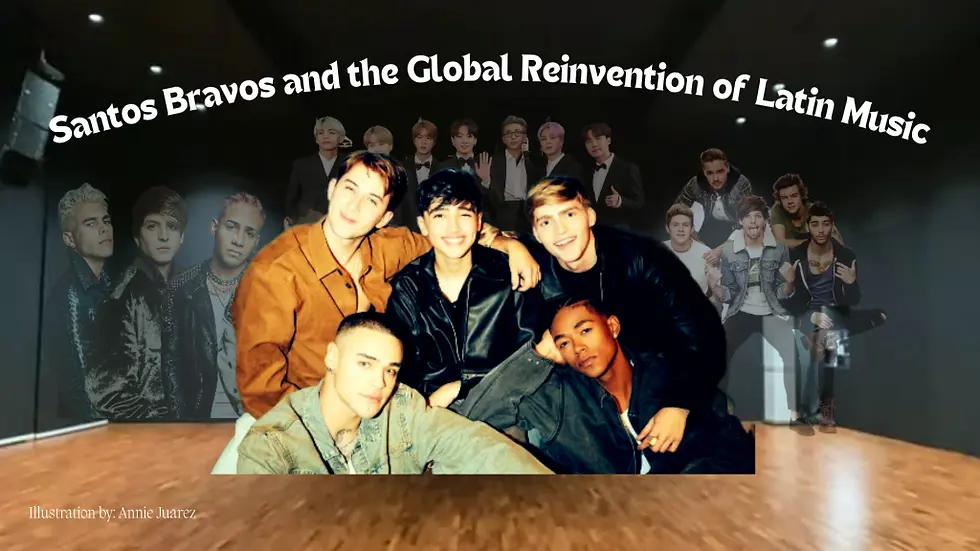
When HYBE, the South Korean entertainment powerhouse behind BTS, announced the debut of Santos Bravos, a new Latin American boy group, global music fans took notice. The group’s arrival marks a bold step in the company’s ongoing strategy to expand its “global idol” model beyond Asia and into new cultural frontiers. Their debut concert in Mexico City drew thousands of fans in person and tens of thousands online, signaling that the experiment had already captured international attention.
More than just another music debut, Santos Bravos represents a cultural test case: can the K-pop formula work outside its Korean roots? HYBE is betting that the same combination of intensive training, high-concept visuals, and fan engagement that built global phenomena like BTS and SEVENTEEN can also elevate Latin talent. However, this project isn’t simply about crossover appeal—it’s about whether the systemized polish of K-pop can coexist with the improvisational passion that defines Latin pop.
The formation of Santos Bravos followed a months-long audition process across Latin America, drawing contestants from Mexico, Brazil, Colombia, and Argentina. The trainees underwent HYBE’s signature regimen—vocal coaching, dance choreography, media training, and language practice—before five final members were selected. Each was chosen not only for talent, but also for charisma, adaptability, and storytelling potential, which are all core pillars of the K-pop “idol” system.
HYBE executives have described this venture as part of their “multi-home, multi-genre” approach to music production. Instead of exporting Korean artists to new markets, they are now importing the Korean production method to local contexts. This model promises to “empower local voices with global systems,” a concept that sounds visionary but also raises complex cultural questions about ownership, identity, and authenticity.
Musically, Santos Bravos blends reggaetón and pop-rap rhythms with the sleek precision of K-pop arrangement. Their debut single, “0 %,” layers Spanish lyrics over trap-infused beats, with choreography sharp enough to rival Seoul’s best idol stages. It’s a sound both familiar and foreign—a Latin heartbeat pulsing through a Korean frame.
For fans, that hybrid sound is thrilling. It promises a new kind of global music that transcends language and geography, merging two of the world’s most dynamic pop traditions. The group’s fandom has already begun spreading across Latin America, Korea, and the United States, showing that cultural crossover can generate real emotional and economic energy.
This project also highlights an ongoing tension in global pop: how to celebrate cultural fusion without erasing the original source. The K-pop system is known for discipline, perfectionism, and brand control, whereas Latin pop thrives on spontaneity, emotion, and improvisation. If Santos Bravos is over-produced or too tightly scripted, it could lose the raw soul that defines the music of its region.
Some Latin fans have already voiced skepticism, wondering whether a Korean company can truly represent Latin identity. Critics argue that the idol system risks flattening regional diversity into a marketable aesthetic of “global Latin flavor.” Others question whether the band’s name, visuals, and marketing lean too heavily on stereotypes—religious imagery, machismo, and romantic passion—that might appeal internationally but simplify Latin identity.
Still, it’s worth acknowledging what HYBE brings to the table: infrastructure, investment, and global reach that few Latin labels can match. For emerging artists, the K-pop model offers stability and career longevity, with rigorous artist development and multimedia storytelling. Santos Bravos benefits from a machinery that understands how to turn musicians into full-fledged global brands.
If this experiment works, it could open the door to a new category of “glocal” music—produced through global systems but rooted in local traditions. Imagine future acts: African K-pop groups, Middle Eastern girl groups, or Southeast Asian idols trained under similar models but expressing their own heritage. Santos Bravos could be the prototype for a new, post-national era of pop culture where identity and globalism coexist rather than compete.
However, success will depend on whether HYBE allows these artists creative autonomy. The company’s biggest achievements in Korea have come when artists like BTS were empowered to tell their own stories. If Santos Bravos becomes too controlled by corporate branding, it could alienate the very communities it seeks to represent.
Cultural hybridity is powerful when it’s reciprocal—when exchange flows both ways. The ideal scenario is not Latin artists molded into K-pop idols, but rather K-pop frameworks reshaped by Latin energy, language, and rhythm. The hope is that HYBE’s producers listen as much as they instruct, letting the Latin members’ authenticity redefine what the idol model can be.
In a broader sense, Santos Bravos embodies the next frontier of pop globalization. The 2010s saw the rise of K-pop as Korea’s greatest cultural export; the 2020s may now see it evolve into a flexible formula adaptable worldwide. Yet as the model expands, questions of cultural ethics, representation, and creative freedom will remain at its core.
Ultimately, the debut of Santos Bravos is less about whether they can top charts and more about what kind of world their success might create. If they manage to balance K-pop precision with Latin authenticity, they could redefine what it means to be a “global artist.” But if they lose sight of the vibrant roots that made Latin music irresistible in the first place, the experiment may prove that global formulas can’t replace local soul.
For now, one thing is clear: the world is watching. HYBE’s leap into Latin America with Santos Bravos is a daring cultural experiment, a fusion of rhythm, discipline, and identity. Whether it succeeds or stumbles, its impact will echo far beyond Mexico City’s stage—into the future of how music, culture, and belonging intertwine in a truly global age.


Comments