
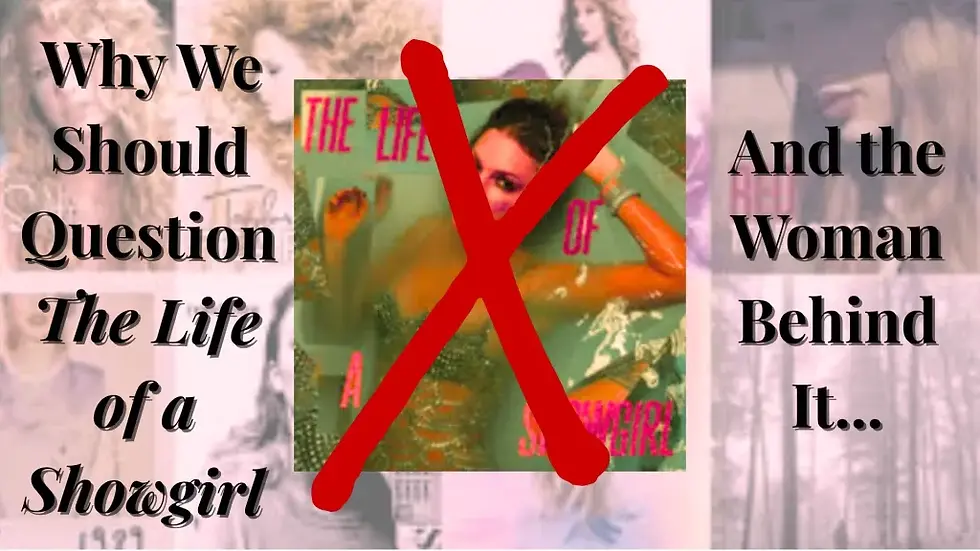
Why we should question “The Life of a Showgirl” and the woman behind it

Originally posted on The Georgetonian on October 17, 2025
Taylor Swift once stood as the pop embodiment of modern feminism — the woman who turned heartbreak into agency and made vulnerability a form of power. However, her newest album, “The Life of a Showgirl,” feels like a betrayal of that promise. Beneath the sequins and staged empowerment lies a collection of songs that are male-centric, emotionally shallow, and, at moments, racially tone-deaf.
Nearly every track revolves around men. Whether she’s mourning, defending, or longing, the subject is always him — his gaze, his love, his power. Even when Swift writes about her fame or sense of identity, it’s filtered through her relationships. The woman who once sang about standing alone now sounds like she’s orbiting someone else’s world.
This dependence makes the album’s feminist messaging ring hollow. Swift’s earlier works, especially “Folklore” and “Reputation,” captured agency and defiance; “Showgirl” feels like surrender. Her autonomy has been traded for a romance narrative that dominates both her sound and public image.
The problem is worsened by the album’s lyrical emptiness. Swift built her reputation on storytelling — sharp details, emotional precision, and an almost diary-like honesty. In contrast, “Showgirl” is laced with vague phrases and self-conscious wordplay: “the optics click,” “they’ve written your name in smoke,” “the spotlight burns.” These lines sound profound until you realize they say almost nothing.
“Cancelled,” the album’s centerpiece, takes that emptiness in a more troubling direction. What could have been a reflection on fame becomes a not-so-subtle nod to conservative talking points. When Swift sings, “Did you girl-boss too close to the sun? / Did they catch you having far too much fun? / Did you make a joke only a man could?” she echoes the anti–cancel-culture rhetoric beloved by MAGA pundits.
The framing is victimhood disguised as empowerment — a reclamation anthem that feels politically aligned with grievance culture. It’s as if Swift wants to have it both ways: the progressive heroine of feminism and the champion of those “silenced” by modern discourse. That’s not boldness — it’s brand management.
This shift can’t be separated from her highly publicized relationship with NFL player Travis Kelce. From lyrics to rollout, his presence is everywhere. Songs like “Wood” blur the line between romance and dependence, and fans can practically hear the marketing strategy humming beneath the melodies.
More concerning, however, is how this relationship bleeds into the racial subtext of “Showgirl.” The song “Opalite” has already sparked discussion for its unsettling undertones. With lyrics describing a woman “too loud, too dark, too much to tame” and Swift’s comparison of herself to a “stone he couldn’t polish before,” the track reads as a commentary on Kelce’s history of dating Black women before her.
The imagery subtly paints those former partners as “rough” or “wild,” positioning Swift’s whiteness as refinement — the “gem he finally kept.” Even if unintentional, that framing perpetuates a racialized contrast that is both stereotypical and damaging. The song’s tone-deaf lyricism turns private jealousy into public microaggression.
Then there’s “Eldest Daughter,” the one critics have praised as the album’s “smartest” track. But even that song collapses under scrutiny. Its attempt at introspection is buried under what can only be described as millennial therapy-speak: words like “boundaries,” “energy,” and “self-care” replace emotional depth with Instagram language.
What could have been a heartfelt confession becomes a Pinterest board of performative vulnerability. There’s no real risk, no confession — just recycled language dressed as insight. It’s emblematic of the album’s larger problem: Swift is fluent in the aesthetics of emotion, but not its truth.
The album also feels alarmingly sanitized — culturally, politically, and musically. In a pop landscape where artists are experimenting with Afrobeat, reggaeton, and global influences, “Showgirl” sounds frozen in a white, middle-American bubble. The refusal to engage with broader sounds or perspectives doesn’t feel neutral; it feels deliberate.
That absence is, in itself, a form of bias. Swift’s whiteness is the unspoken center of the record — never interrogated, never expanded upon. Instead of evolving alongside the culture that helped her rise, she retreats into a nostalgic version of herself: safe, marketable, unchallenging.
Even the production mirrors this insularity. The songs shimmer, but they rarely surprise. Every risk is calculated, every confession sanded down for palatability. What’s left is a performance of empowerment that never risks authenticity.
In the end, “The Life of a Showgirl” isn’t about self-discovery — it’s about self-preservation. Swift presents the illusion of growth while clinging to old patterns: male dependence, marketable feminism, and lyrical vagueness that avoids real vulnerability.
She once turned pain into art; now she turns image into product. Beneath the polished exterior, “The Life of a Showgirl” reveals an artist terrified to evolve — one still defined by the men she dates and the brand she refuses to outgrow.


Comments